Leave a comment

The Delicate Marsh Fern

An intermediate sized fern of the eastern U.S., the marsh fern prefers the wet soils of freshwater wetlands.

Fern leaves are called fronds. The shape of the frond and how it is divided helps to identify it. Marsh fern has a sterile frond (a leaf without spores) with many leaflets that are also divided. Marsh fern’s fertile fronds have a profuse amount of spores (fern seeds) on the underside of its leaves.

So, the next time you are in a wetland area and see ferns, you can tell the one you are with to check out those fronds!

Leave a comment

The Sensitive Fern

Curious? You are not going to hurt the feelings of this fern. It is a fern sensitive to cold weather and the fall frosts. Like many ferns, it grows in freshwater wetlands and moist woodlands in the eastern half of the U.S.

Leave a comment

The Hairy Fern

One of the earliest ferns to poke through the ground in freshwater wetlands in the eastern U.S. and Canada is the Cinnamon Fern. As is true of many ferns when this plant first appears, it looks like the top of a fiddle thus it is called a fiddle head. This “fiddle” will unfurl into a frond (leaf) reaching heights of three to four feet.

Cinnamon ferns are covered in light cinnamon-colored woolly hairs rendering the plant unpalatable to wildlife. Yellow warblers, hummingbirds, thrushes and other birds harvest these hairs to line their nests. The fern’s fertile fronds are plume -like and produce spores that are a cinnamon brown color.

This fern is often planted in landscapes in yards for native bog gardens. It thrives in shady areas with wet acid soils.

Leave a comment

The Robin of the Butterfly World

It is early April and even though the weather is still chilly, today is a warm spring day. As I walk into the pine barren woodlands in a park on Long Island in New York, I see nothing but a gray landscape made of leafless oak trees and various heaths. Slate colored juncos (sparrow sized gray birds that winter on Long Island), disturbed by my presence, fly up into a scarlet oak tree.

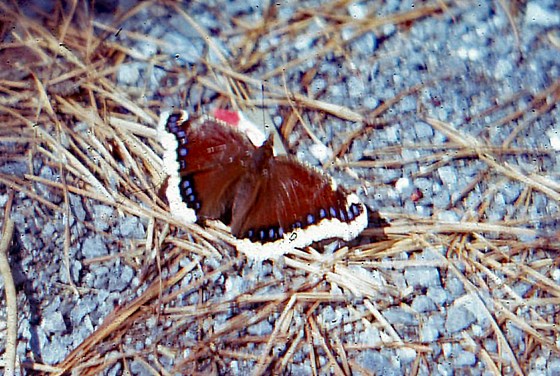
Around a bend in the trail I see something fluttering and when I get close to it, I see the first butterfly of spring – the mourning cloak butterfly. It landed on a candy wrapper strewn on the ground where the butterfly basked in the sun’s warming rays. Its opened wings revealed a velvety brown top with blue dots and dull yellowish wing edges.

The reason for seeing it so early is that it hibernates for the winter in tree hollows and in the crevices of tree bark. On warm spring days this butterfly emerges from its winter slumber and seeks a mate. The eggs are then laid on the slender branches of willows, poplars and elms. The generation that hatches into caterpillars and undergoes metamorphosis will emerge as adult butterflies and will be next year’s butterflies making it one of the longest living butterfly.

Once warmed, the butterfly lifted off the candy wrapper and flew into the woodlands out of my view. I look forward to seeing other species of butterflies when as the days become warmer.

Leave a comment

How Can You Tell a Forest is Old?

If you find extensive tracts of the Wood Anemone, a small wildflower of shady deciduous woodlands, you are probably in an older, established forest. It takes about five years for anemones to flower and longer to spread through underground rhizomes. This plant prefers moist, mucky soils and in New York, I have seen it growing in red maple wetlands.

This wildflower’s dainty white flowers are pollinated by hover flies, a species that eats nectar and pollen. It is a poisonous plant if eaten and folklore nicknamed it the wind flower because its blossoms flutter in the breeze.

This is just one indicator of a mature forest. The types and sizes of trees, a rich leaf litter, multi-layered canopies and even the species of wildlife can all help determine how old a forest may be.  If you are in the eastern U.S. or Canada, and see widespread areas of the wood anemone, you can assume it’s a relatively undisturbed older forest.