Leave a comment

The Vanishing Butterfly

It is May on Long Island and as I walk down a trail that winds through oak woodlands, my attention is drawn to flashes of blue about a foot or two above the ground. As I get closer, I see that the flashes are from a metallic blue colored butterfly fluttering across the trail.

I raise my camera to snap a photograph of this little butterfly and follow it as it dashes across my path into a brushy area. It suddenly disappears. I lower my camera to see if I can find it, but it is gone! I see another one crossing the trail and follow it and it too disappears.

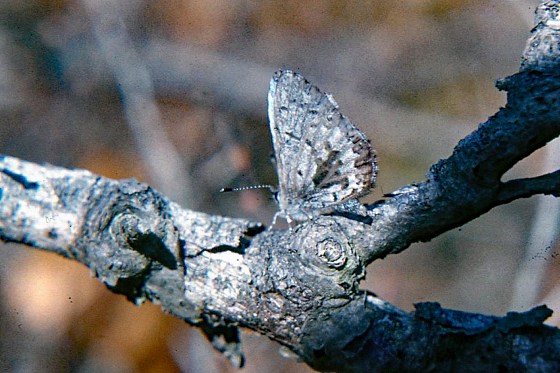
Finally, I watch a third one intently as it flies into the woodlands and again it vanishes. Looking closely at the last place I saw it, I finally find it. It landed on a dead gray branch, closing its wings revealing a grayish underside that blended perfectly in with the branch making it nearly impossible to see.

Alas! It is the spring azure butterfly. Sky blue on top and gray underneath makes this insect a master of deception. It is a challenge to any bird that is looking for a tasty butterfly for lunch.

It makes sense for the butterfly to be abundant here. One of its host plants is the wild blueberry, a shrub that is plentiful in these oak woodlands. Spring azure caterpillars will devour the blueberry leaves and after a couple of weeks will form chrysalids where they will overwinter. In the spring they emerge as adult butteflies to begin the process over again.

Many insects use camouflage as a way to protect themselves from predators. If you watch any of the nature shows on your electronics, you probably have seen insects that look like branches and bugs that look like leaves. You do not need to travel to exotic places to see this in action. The spring azure butterfly in ubiquitous in North America. If you live near oak woodlands or freshwater wetlands where blueberries and viburnums grow, you may see the blue flashes of spring azure butterfly.

Leave a comment

The Elusive Fern


It is almost impossible to see this fern unless you get on your hands and knees and look for it in peat bogs, sphagnum hummocks and wet interdunal swales. That is because this fern is tiny. It grows only to a height of three to four inches. Additionally, it does not look like your typical fern. Its sterile fronds (fern leaves) are small curly and grass-like, thus its name – curly grass fern. Its fertile fronds (spore producing fern leaves) are unique and look like a small hairbrush on the end of a single stalk.

This is a very rare plant only found in a few places including Maine, Delaware, New Jersey and Canada. In New York, it is an endangered species. Although many botanists have combed habitats this fern grows in, it remains a secretive plant.


Leave a comment

The Tasty Fern

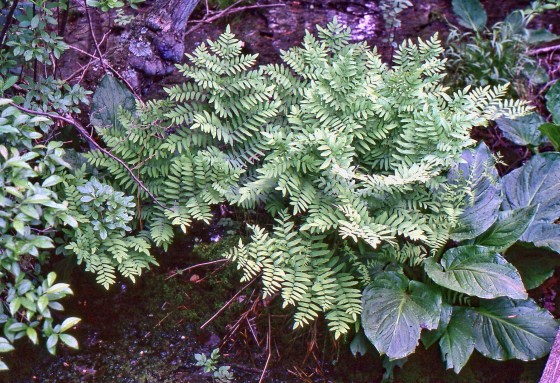
One summer day, when I was walking along a wetland trail in New York, I was about to cross a small spring fed brook, when I happened across a muskrat. I stopped dead in my tracks to observe it without frightening the muskrat away. It walked up to a four-foot tall royal fern and proceeded to pull it down, eating it frond by frond. I watched it devour the entire fern leaving behind nothing of the p0lant behind.

The royal fern is a plant that prefers wetlands often growing side by side with skunk cabbage. It has two types of fronds (leaves) – fertile fronds that have the spore cases and sterile fronds that are the leafy part of the plant.

I shall always remember my encounter with the muskrat eating the fern. I am not sure I would find quite as delicious.

Leave a comment

The Aromatic Fern

Your sense of smell can be helpful in identifying plant species. Wintergreen plants smell just like wintergreen life savers. Many of the mint species have minty odors and garlic mustard, a weedy herb, smells like garlic.

The hay-scented fern has a distinctive aroma of freshly cut hay when crushed or bruised. It is an intricately cut fern which separates it from many other fern species. It has spores on the undersides of its leaves. I have seen it growing in a variety of habitats from freshwater wetlands to dry woodlands with rich soil. It tends to grow in large colonies where found in eastern North America.

Be sure you have an idea of what the plant might be before crushing a leaf and sniffing it. You certainly do not want to sniff every plant you see. I was both amazed and dismayed at fellow students, in my college botany class final, who did not recognize poison ivy and made the mistake of crushing and sniffing it to determine what plant it was.

Leave a comment

The Fern Found Around the World

This fern grows on every continent except for Antarctica. It favors dry acidic poor soils. I have seen this fern in oak woodlands where scarlet, white and black oaks dominate a landscape with an understory of low-bush blueberries and huckleberries.

The bracken fern also grows in disturbed areas where it appears to be weedy. Its rhizomes (roots) can grow up to ten feet deep to find moisture. This is an adaptation that enables it to grow in dry woodlands.

Its fiddleheads, covered in silvery hairs, emerge each spring and unfurl on a single stalk that forms a broad triangle. It does not form dense thickets like other ferns, but you tend to see it many in one area.

If you see a fern in dry oak woodlands, whether you are in Europe or Australia,it just might be the bracken fern.