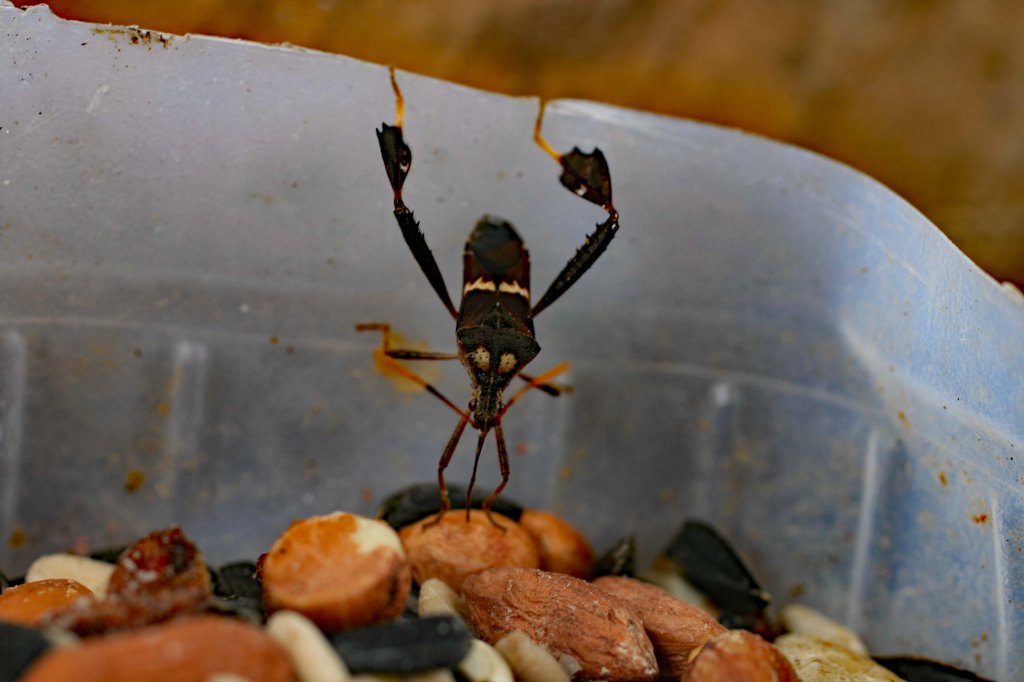
In the dappled sunlight of a late summer morning, my garden became alive with the soft humming of bees and the silent fluttering of butterfly wings sipping nectar from the backyard flowering bushes. Though it was summer, birds still visited the feeders to feast on various seeds. As I sat on my porch watching the morning wildlife show, I spied a creature, small and striking, armored and unique, in the bed of the seeds the birds had not yet eaten. It was the eastern-leaf-footed bug, named for the delicate, flattened extensions on its hind legs that resemble leaves.
It is a true bug, part of a diverse group of insects that includes aphids, cicadas, and hoppers. These insects have needle-like mouth parts to pierce and draw out the nourishing juices of plants. The eastern leaf-footed bug’s body is elongated and shield-like, shaded in ashy gray tones that blend in perfectly with the twigs and stems of plants. It has a white belt around its midrib and long, probing antennae tipped in orange, which help the bug sense its surroundings.
Its life began as a nymph, hatching from a cluster of eggs nestled in the leaves of plants in the warmth of late spring. It was a tiny bead of amber, defenseless, facing a world of opportunity and danger. Its siblings hung together for safety, sucking the juices of the plant they were born on, moving together as one unit. Their red color warned predators of their distastefulness.
As the days lengthened and the sun grew brighter, the nymphs shed their skins, each molt bringing them closer to adulthood. Their skins hardened, and the leaf-like appendages on their hind legs expanded. They began to venture from the safety of the bush to find fruit and seeds to pierce with their sharp beaks to suck the life-sustaining juices. One of them found its way to my bird feeder with a banquet of seeds to feed on. Piercing the shell of one of the seeds, it began to drink the seed’s nutritious fluid.
I can only imagine the dangers it faced finding its way to the feeder. Hungry birds with keen eyesight might spot it, and preying mantids and spiders might find it amongst the shadows of the leafy vegetation. Its only defense is to freeze, hoping these predators don’t detect it. If they do, it will emit a foul odor, making them unappetizing.
At summer’s end, the eastern leaf hopper’s cycle is nearly complete, and as the days shorten, the air grows crisp, and the leaves on the plants wilt, these bugs retreat to the safety of the leaf litter for the winter. Though many will freeze to death, the eggs they left behind will ensure the survival of their kind for the following year.
I returned to the feeder as the sun dipped below the western horizon. The bug had already slipped into the brush, likely clinging to the underside of a leaf. My encounter with this small creature reflected something we all share – a story of transformation, adaptation, and resilience.
 naturechirp
A wonderful insect. Thanks for the information
LikeLike
Gary, this is an insect that is unfamiliar to me. Thank you for the introduction. In Florida, we have many bugs, including annoying ones! 🐜 🦟🕷️
LikeLiked by 1 person
Hi Cheryl, This photo was taken in my backyard in Florida when I lived there. Much to the chagrin of gardeners, they wreak havoc on tomatoes, a favorite food of theirs. Oh yes, lots of annoying bugs in Florida. I hate those palmetto bugs and the tiny sugar ants that find their way into your home.
LikeLiked by 1 person
We are experiencing a battle with ants right now. UGH!
LikeLike