Leave a comment

Delightful Discovery Part 2

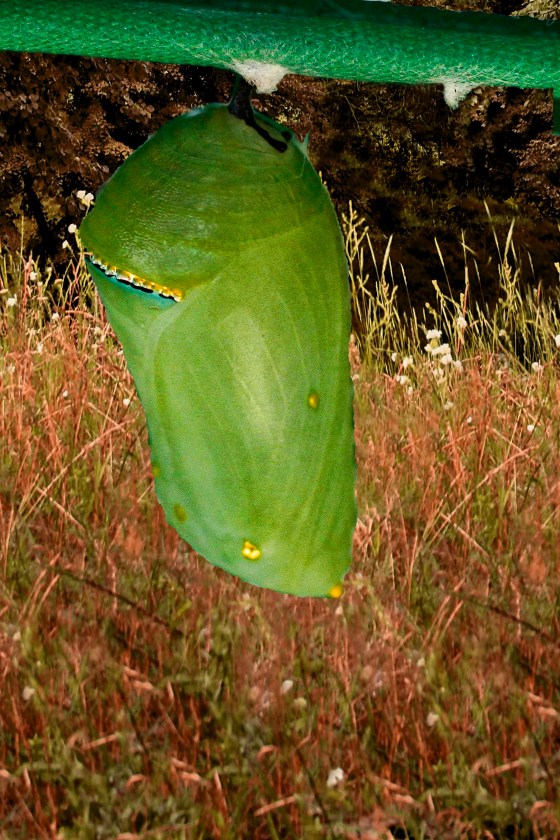
It is not long before one of the queen caterpillars spins a wad of silk on a twig and attaches its last set of pro-legs to the silky sac.   Hanging like a bat, the caterpillar sheds its skin and transforms into a lime green pupa called a chrysalis.

It is in this chrysalis that the process of metamorphosis takes place. A process where the caterpillar transforms into an adult butterfly. A day later, Anne and I can see the beginnings of the wing formation within the pupa.

In about ten days, the conversion will be complete and an adult butterfly will emerge. Like proud parents, Anne and I await the birth of the queen butterfly.


Leave a comment

Delightful Discovery!

My adorable wife Anne comes through the front door excitedly and announces that there are caterpillars on our milkweed plants, but they are not monarchs. She tells me they look similar but seem to be another species.

I follow her to the corner of our house where a sickly milkweed plant is struggling to survive after it was nearly completely devoured by monarch caterpillars a few weeks earlier. She lifts the leaves to show me three tiny caterpillars munching on the leaves. I agree that it is not a monarch, snap a few pictures and come in the house to research what it could be.

It did not take me long to discover that the caterpillars were queen butterfly larvae that eat milkweeds just like monarchs do. After all, they are related.

We checked on the caterpillars the next day and it is amazing how fast these caterpillars grow. One was not looking great. The back half of it was turning black probably from some virus or parasite.  We brought the two remaining caterpillars into the safety of a butterfly “cage” with some milkweed so that I can photograph the chrysalids the caterpillars will form to turn into butterflies.

To be continued…

Leave a comment

Snowy Egret Goes Surf Fishing

I have observed egrets for decades. I have seen them hunting in saltwater marshes, freshwater wetlands as well as in the shallows of ponds and streams. To my surprise I saw a snowy egret wading in the ocean waves lapping the shore where it ate small fish caught in the surf at Cocoa Beach in Florida. I have never seen egrets in the Atlantic surf on Long Island where I grew up nor have I seen these birds in the waves on the rocky beaches of the Island’s north shore.

Yes, many people will probably tell me how they see egrets on the beach all the time. But I have learned over the decades that you can never be too old or too experienced to see behaviors that are new to you. And this is what makes nature so exciting and continues to beckon me to see new things in retirement.


Leave a comment

A Duck That Nests in Trees

In pine barren wetlands, on New York’s Long Island, where black gum and red maple trees dominate the landscape, a mother wood duck calls to her ducklings from the edge of a small pond. The ducklings are only a day old and covered in down. They are still in the nesting cavity of an old red maple tree, 30 feet high where mom laid 12 creamy white eggs a month earlier.

One by one the ducklings climb up the inside of the tree cavity, poke their heads out and bravely jump, tumbling down, crashing through branches until they hit the ground. They are so agile, they are uninjured by the fall. Each duckling finds its way to mom until they are all together when they swim with her eating aquatic plants and insects.

Wood duck populations declined drastically in the late 1800’s and into the early 1900’s but has made a comeback and their numbers are secure.

The ducklings will face many challenges as they grow. Snapping turtles, alligators, snakes and hawks will eat many of them, but enough will survive for the species to sustain its current levels.

Leave a comment

Boat-tailed Grackles Evoke Nostalgia

One of my fondest memories is being greeted by the calls of boat-tailed grackles at the Florida welcome center after driving nearly a thousand miles from New York. The calls along with the warm Florida sunshine signified an escape from the cold wintry weather of the north and the start of our family vacation.

Boat-tailed grackles are a coastal species endemic to Florida and along the Atlantic Seaboard from Georgia to New England. It is omnivorous – it eats seeds, fish, snails, berries and insects.

Recently, I observed one in the surf of Cocoa Beach, Florida where it walked in the wash of the incoming waves plucking small fish and other sea life from the salty water. These grackles also like cookies, chips and other snacks that they steal from unsuspecting sunbathers’ bags when they are not looking.

I have also seen these birds forage along the edges of freshwater lakes here in Florida where it wades in the shallow water to eat tadpoles, shrimp and aquatic insects.

Though I now live in Florida and see and hear these birds every day, it still brings back fond memories of our visits to Florida.