2 Comments

In Defense of Solidago!

This slideshow requires JavaScript.

As I walk along the edge of the woodlands in my Florida community on this autumn day, my attention is focused on two plants growing side by side. Both are in full bloom, one with golden-yellow flowers and one with plain greenish blossoms. One is responsible for causing miserable symptoms of hay fever; the other is mistakenly blamed for this pollen allergy.

Each fall millions of people with hay fever suffer with sneezing, itchy eyes, sore throats, stuffy nose and other similar symptoms. The cause is an allergy to ragweed pollen. From mid-summer until the first fall frost, each ragweed plant spews upwards of a billion pollen grains into the air. These particles are lightweight and carried for hundreds of miles by the wind. The ragweed pollen that is affecting you in the east, may have drifted from the mid-west. Ragweed is ubiquitous. It grows in parks, along the edges of roadways, in the electric right of ways, empty city lots and perhaps even in your backyard.

What does ragweed look like? Well, many think it is the golden flowering plant that so prominently blooms this time of year, but it is not. The plant with the deep yellow flowers is goldenrod. Ragweed flowers are far from showy. The blossoms are tiny pale green that dangle on long stalks so the wind can whisk the pollen off into the air to other plants for pollination to occur. Goldenrod produces pollen, but not in the great quantity that ragweed does. This is because goldenrod does not depend upon the wind to spread its pollen; its pollen is heavy and sticky. Goldenrod is reliant on butterflies and bees to carry its pollen from one plant to another. Goldenrod offers sweet nectar to insects for this service.

I look down at the beautiful goldenrod and feel bad for it because it is wrongly accused of causing hay fever. This falsehood is often perpetrated by the media. I have seen news stories on hay fever where pictures of goldenrod are shown instead of ragweed. Try googling images of ragweed and see what appears.

So if you are a hay fever sufferer, don’t blame it on the beautiful colorful fall wildflowers that adorn the fields and woodlands. Blame it on ragweed and blame it on the wind!
Leave a comment

The Intelligent Butterfly!

This slideshow requires JavaScript.

I lead Anne down a grassy hill from where the community clubhouse sits to the cypress swamp along the edge of Lake Tsala Apopka. The sun is still rising in the east and shade shrouds the forest except for a few rays that penetrate through small openings in the tree canopy. We stand there for a moment and suddenly, flying from the deepness of the wetland we see a butterfly that has long and narrow black wings with zebra-like yellow stripes. Its wings wave rather than flap. It has a more deliberate flight, unlike the seemingly erratic flight of other butterfly species. It is the zebra long-winged butterfly, Florida’s state butterfly.

Zebra long-wings are actually “intelligent” butterflies. They remember where their nectaries are and go back to them each day. Long-wings even learn the locations of specific nectar producing plants and revisit the plants each day. These butterflies return to the same roost each night and even have somewhat of a social order. The oldest choose the prime locations to roost at the expense of the youngsters.

Another interesting fact about these beautiful butterflies is that in addition to sipping nectar, they eat pollen. Long-wings have saliva capable of digesting pollen. It is rich in protein and this helps Zebras live longer than other butterflies. It also aides in the production of viable eggs.

Although Anne has enjoyed seeing these magnificent butterflies, she grows impatient with all the time I spend photographing the butterflies and yes, I admit, ignoring her. “Take your time,” she tells me, “I’m going for a swim in the pool.” I am mesmerized by the scene before me. I watch as one, two, three, and more zebra long-wings move smoothly through the air like stingrays glide through salty water. It is like watching the tranquility of a tropical fish tank. It is very calming, relaxing… peaceful. Oh well, like the long-wings, I must return to my roosting site and I leave this serene setting.  But, I’ll be back for another dose of nature’s Xanax!

Leave a comment

Where do Butterflies go in the Winter?

This slideshow requires JavaScript.

It is October in Florida and although we look forward to the break in the extreme summer heat, Anne and I are anxiously awaiting the fall migration of birds and butterflies. Yes, I said butterflies. In northern U.S., some species of butterflies over winter in the hollows of trees. Others go into an animated suspension in the protection of a pupae.

Most people are familiar with the great Monarch migration that occurs each spring and fall. Monarchs travel great distances to winter over in the Sierra Madre Mountains of southern Mexico. Florida is also host to many species of butterflies that migrate from Virginia, Georgia and the Carolinas to escape deadly fall frosts and the icy death grip of winter.

Anne and I walk along the edge of the woodlands that border Lake Tsala Apopka to see what butterflies are out on this beautiful morning. But because it is early, the woodlands are still dark and butterflies are awaiting the warm rays of the sun to stir them from their slumbers. We walk up a gentle grassy rise towards the clubhouse where the flower beds bathe in the early morning sunlight. The gardens are alive with butterflies attracted to the nectar within the blooms of the flowering shrubs.

We see one of the species of butterflies that migrates here – the long-tailed skipper. Although some individuals are here year round, the greater numbers we are seeing is probably from the influx of this species from the north. “Look at that beauty!“, I tell Anne as I raise my camera and snap a few images. I can see that Anne is not impressed. This butterfly belongs to skipper family named so because of its quick dart-like flight. Skippers look more like moths than butterflies because of their dull colors, large hairy bodies and big heads. While butterflies fold their wings when resting, moths keep their wings spread open. The skipper butterfly seems like half moth and half butterfly. It often keeps one set of wings spread out like a moth and the other set angled up like a butterfly.

To reward Anne for her patience, I lead her back to the woodlands to discover an exotic looking butterfly that prefers shaded areas. The sun is higher in the sky and the darkness of the woodlands has given way to a forest that is now shaded but sprinkled with sunlight. The woodlands are now alive with this sub tropical butterfly. Hmmm! That sounds like my next blog subject!

2 Comments

Our Morning with Butter-wings

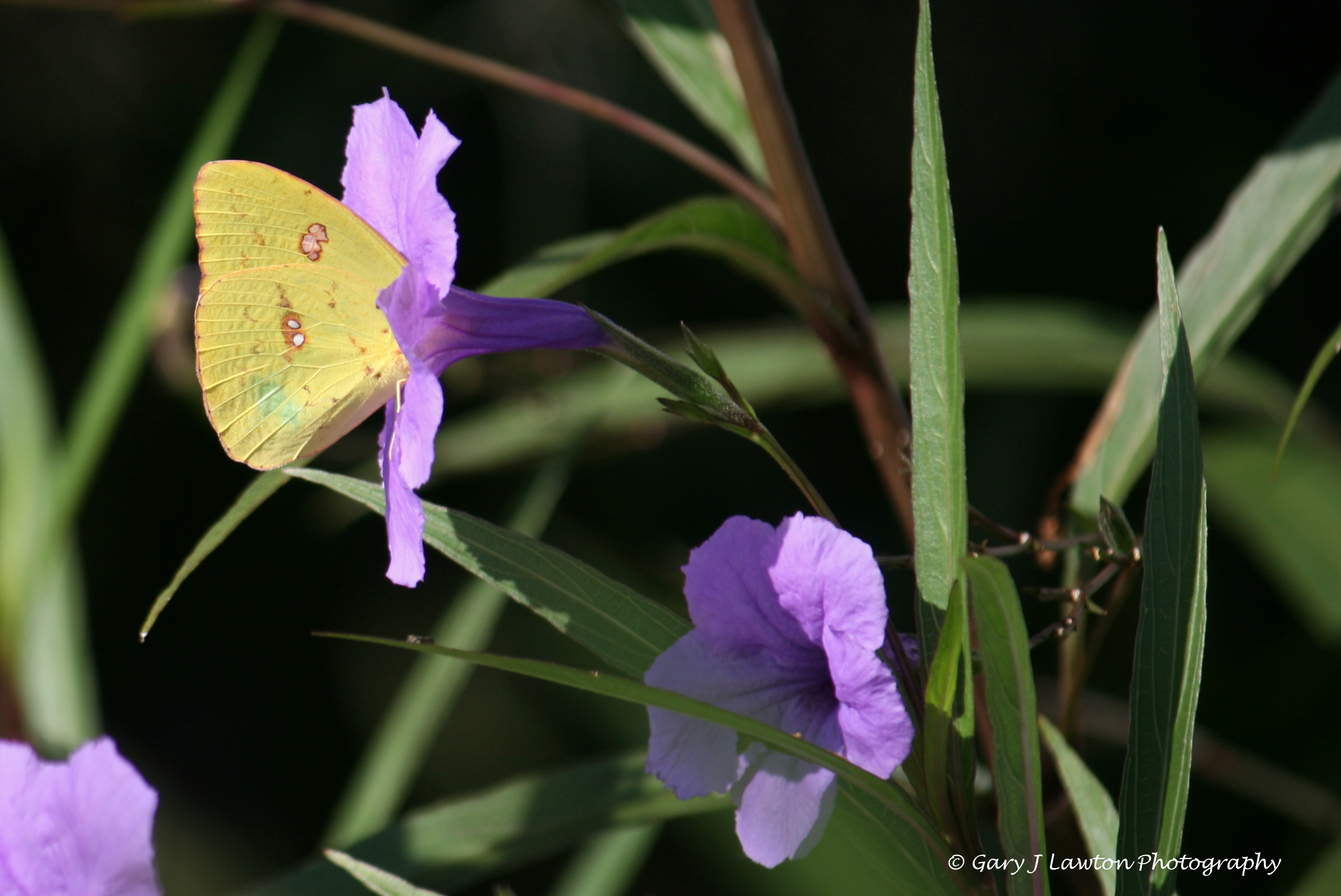
Cloudless Sulphur butterfly reaches deep inside the petunia flower to sip the blossom’s nectar.

Anne closes the front door as we leave our villa to begin our morning walk. I see a medium-sized butter-yellow butterfly fluttering around the red hibiscus shrubs that stand as sentries on each side of our garage. These plants prop up about a dozen red flowers each day. Although cloudless sulphur butterflies inspect these crimson adornments, I have yet to see this butterfly sip nectar from the hibiscus blooms.

We walk, past other homes, on a concrete sidewalk paralleling a black paved road that leads to Lake Tsala Apopka. The street curves to the east and we enjoy seeing the rising sun and smelling the fresh air cleansed by early morning rains. A sulphur butterfly joins us for a moment pops over our heads and continues in the same direction, but takes a straighter course towards the lake. I assume it is searching for sweet nectaries to eat breakfast. It is amazing how quickly this butterfly travels. Its speed is faster than I can run, trust me. It continues out of our view.

We walk past the community clubhouse where we pause to enjoy the garden of plantings. Several cloudless sulphurs flutter from one flower to another. The sulphurs favor one shrub in particular – the purple showers shrubs, supposedly a sterile subspecies of the highly invasive Mexican petunia. The plant  has long blue-violet tubular flowers. It is a perfect fit for these butterflies since they have an extremely long proboscis, a straw like tube that it uncoils to reach the nectar deep inside the blossom.

I focus on one individual as it momentarily lands on one blossom, then alights and rises up beating its wings a couple of times and floats down to a different flower.  I wonder if it is the sulphur butterfly that briefly joined us for the walk. Did it know this was the McDonalds of the area? Or was it happenstance that it found it.

After walking along the lake, Anne and I head back to our home and see more sulphurs flying in the neighborhood. “Head east to the clubhouse,” I tell them. There is lots of food there!

2 Comments

How Did the Butterfly Get Its Name?

One theory is that Europeans called this insect the butterfly because of its yellow color.

Personally, I always thought this beautiful insect should be called a flutter-by, not butterfly. Although, sometimes I call them special words I cannot post here when they don’t cooperate when I am trying to photograph them.

Some think the butterfly got its name because many of the European butterflies were the color of butter and thus named butterfly. But there are many butterflies in Europe that have a plethora of colors like those here in the new world.

It is said that in early mid-evil times in Europe, cows produced milk after their calves were born in the spring. Some of the milk was churned into butter at the same time that the butterflies appeared and thus the word butterfly was born.

Another story is that witches disguised as butterflies would fly to the farms steal the farmer’s milk and butter.  Because butterflies undergo changes, they were associated with witches that could change into butterflies.

The Russian word for butterfly translates to “bowtie”and the Greek word means “soul”. The old English word for butterfly is buterfleoge that translates to “butter flying” creature. The old Dutch word for butterfly is boterschjte which literally means “butter shit”! Oh my! This is because the color of its excrement is an oily yellow. You know, now that I think about it, I never saw a butterfly take a dump. Actually, butterflies don’t so I have no idea how this one came along.

Food for Thought….

The old German word for butterfly is botterlicker that translates to “butter licker” so let’s go with this thought. Male butterflies are attracted to mud puddles where they suck up some of the water to take salts and minerals. This is important because the males integrate these nutrients in their sperm. When the sperm transfers to the female so do the salts and minerals. This improves the viability of the eggs. Could it be that, in early European times, male butterflies entered open windows, found the butter and sucked up the salts and minerals? And thus were called butter lickers because of that? There is no evidence that I can find to support this, but it sounds plausible.

What do you think?