2 Comments

The Amazing Bug!

As Anne and I enjoy watching butterflies sipping nectar from our milkweed flowers and monarch caterpillars devouring milkweed leaves, we see small orange and black colored insects on the plant’s seed pods.

These insects are large milkweed bugs that eat milkweed seeds. This bug has a long proboscis that pierces the seed pods and injects digestive enzymes that liquify the seeds. The insect sucks the life sustaining liquified nutrients through its straw-like proboscis to nourish this insect.

Toxic compounds, not harmful to the milkweed bug, is also absorbed making bug distasteful and poisonous to any bird that may try to eat it. The vivid patterns of orange and black, the same seen on monarch butterflies, warn potential predators not to eat it.

Like monarchs and dragonflies, the large milkweed bug also migrates south to avoid the bitter winter and returns each spring and can be found as far north as Canada.

Some people may think of these insects as infestations and damaging to plants, but it only lives on milkweed and we have never seen damage to our plants because of them.

Leave a comment

A Queen is Born!

The queen caterpillars we found on our milkweed plants have grown, pupated and are about to hatch. We see one of the chrysalids (butterfly pupa) turn from a spring green to a dark color signifying the impending birth of the adult butterfly. Soon the butterfly breaks free of the chrysalis, hangs on to the shell of the pupae and drips off. We watch as the delicate creature pumping life supporting fluids throughout its body and inflating its wings. Once fully expanded, the wings are opened to allow the sun to dry them off. Once dried the Queen alights and in a moment it is gone.

A few days later as Anne and I are checking the milkweed plants, Anne excitedly points to a Queen butterfly laying eggs on one of the milkweed plants. We wonder if it is the same one that hatched from out milkweed patch. If so, we look forward to seeing her children.

1 Comment

Voracious Caterpillars

My wonderful wife, Anne, ventures out one morning to check on the milkweed plants growing alongside our home. To her dismay the leaves on the milkweeds are nearly gone. Upon closer examination, Anne discovers the reason why. There are a dozen or so monarch caterpillars on the plants eating the leaves, the seed pod casings and the tender twigs.

She moves some of the caterpillars to another batch of milkweed plants nearby. So we head to a nearby nursery to buy more milkweeds to insure there is enough food for them to successfully pupate and emerge as adult butterflies. It is costly to do this, but monarch populations are decreasing so anything we can do to help them survive is worth the money.

Leave a comment

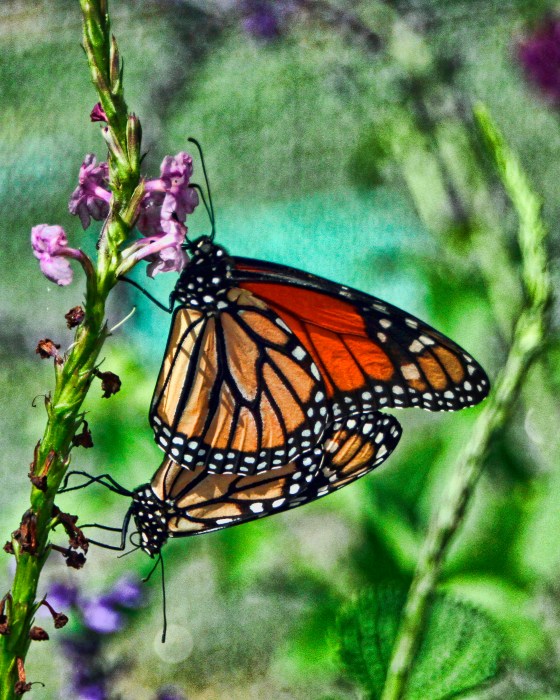
Mating Monarchs

I caught these two butterflies in action. Once the eggs are fertilized, the female will seek members of the milkweed family to lay its eggs. It will not be long before the eggs hatch and we find caterpillars munching on the milkweeds in our garden.

Leave a comment

Lizard Sex

These brown anoles were being amorous on the sidewalk to my front door.  The female will lay eggs in the moist soil of our flowerbeds. The warmth of the Florida sunshine is enough to incubate the eggs until they hatch about a month later. The little baby lizards are on their own to find insects to eat and to find shelter to stay safe from birds, snakes and toads.

Brown anoles are native to Cuba and the Bahamas but have spread into Florida and other Gulf Coast States and north into southern Georgia. These lizards came by boat and through the pet trade. In the U.S. mainland, they are considered an invasive species and probably negatively impact the native green anole population.

These anoles thrive in the disturbed areas; that is why they are so common in housing developments and resorts here in Florida.