Leave a comment

Christmas in Paradise


This slideshow requires JavaScript.

Lighting the Menorah, installing decorative lights on our houses and bushes, hanging mistletoe, wrapping gifts for friends and family – these are just some of the activities that take our time during the holiday season.

When you look in the mall for presents for loved ones, there are egrets along our waterways looking for food to survive the winter.  As you wrap those gifts in colorful paper, spiders are wrapping bugs they caught in sticky webs. When you sing God’s praises in sanctioned churches, birds are singing from evergreen cathedrals. While you shop in food stores for holiday feasts, squirrels are digging up caches buried in the fall. These are the sights and sounds of Christmas to me.

I leave you with this gallery of pictures of God’s creatures living each day as an ordinary day even Christmas. When you shop, wrap and open gifts, drink spirits, install and light up decorations and light the menorah, think of these creatures that these days are just another day in the paradise we call planet earth.

Leave a comment

Webs of Life and Death

The early morning mist forms droplets on flowers, leaves and twigs. The moisture that accumulates on our sloped roof forms droplets that glide down off the edge, splashing on the leaves of plants that border our house’s foundation. The stillness of the air and the intermittent drip… drip, drip… drip is soothing, mesmerizing. I linger for a while outside to enjoy this tranquil setting. Gazing at the suburban landscape on manicured lawns, I notice dozens upon dozens of spider webs on the grass. The entire neighborhood is speckled with these webs as far as the eye can see. There are hundreds, if not thousands of webs.

The webs are also adorned with water droplets beaded on the silk strands that form the intricate lattice. Thick silken threads attached to the blades of grass support the web. Thin silver-white threads form an entangled mesh that is flat and wide on top with a funnel that twists down into the grasses. The webs look like tornados, frozen in time.

These webs are evidence that grass spiders are abundant here. The spider hides deep within the funnel poised to pounce on any insect that has the misfortune to land and become entangled in the massive deadly netting. Once subdued, the insect is either eaten or dragged down into the funnel and sucked of fluids.

Judging from the sheer numbers of webs in the neighborhood, these arachnids must eradicate a good amount of insects each day. By removing mosquitoes from the environment, they remove pathogens such as West Nile virus and other insect borne diseases. Though these spiders are not venomous, research is discovering that the venom of poisonous spiders may help to treat arthritis and certain heart ailments.

The clattering of Florida san dhill cranes breaks the silence of this misty morning and I return to the front door and watch the cranes walk down the street. They walk onto the neighbor’s lawn where they shove their long bills into the grass, eating worms, bugs and perhaps even spiders. Such is the web of life.

Leave a comment

Weekly Photo Challenge: Reflections

Leave a comment

My December Butterfly

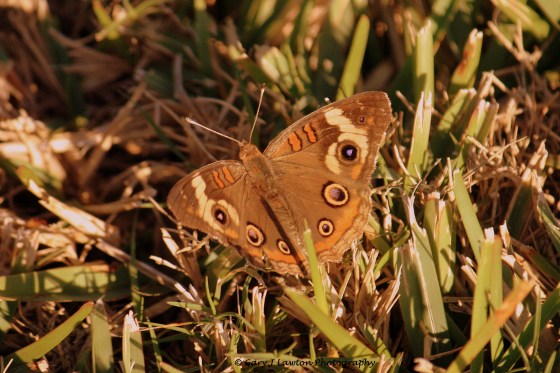
Eye spots on the common buckeye deceive enemies.

Eye spots on the common buckeye deceive enemies.

Sleeping late in the morning is a benefit of retirement. There is no need to get up early to go to work or see the kids off to school. You get up when you get up. Anne and I climbed out of bed a little past 9:00 a.m., conducted our morning routines, had breakfast and slipped on shoes to begin our daily morning walk. This December morning is beautiful. The sun is shining, there’s not a cloud in the sub-tropical deep blue sky and the temperatures climbing into the 80s.

We always walk towards the lake front to see what birds might be visiting us for the day. And we are rewarded with the site of a little blue heron wading in the shallows picking off small fish. Two American coots, duck-like birds are dabbling for food just off shore. Double-crested cormorants are sitting on a log a hundred yards off shore, preening their feathers. A phoebe calls from atop a post of the floating dock. It wags its tail from time to time, a telltale sign that it is a phoebe.

We are so focused on the water, that we do not see what is flying just inches above the grass behind us. It isn’t until we walk along the concrete sidewalk that parallels the lake that I see it. It is elusive, but I follow it and it lands on the grass about 20 feet away. Focusing on the spot it landed, I walk slowly towards it. But my body casts a shadow where it landed and it flies up. I see that it is a butterfly, but it is too far for me to determine what species it is. It lands again; I get within ten feet of it and focus my camera on the spot the butterfly landed.  At first I could not find it, but then I pick it up in my viewfinder and discover that it is the beautiful common buckeye butterfly.

The buckeye is native to Florida and southern Canada and Central America and Mexico and the California coast, but not in the northwest U.S. It loves open sunny areas and that is exactly where Anne and I observe it. It has eight eye spots, two on each of its forewings and two on each hindwing. These prominent spots divert attention away from the insect’s body and confuse potential predators by making it seem bigger than it really is.  Although it seeks flowers of the composite family for nectar, you may see it laying eggs on members of the snapdragon family, the host plant for its caterpillars.

We are just amazed that even though it is winter, we are able to see such beauties. Coming from New York, you are not blessed to see any butterfly during the winter months. Now during our walks we will be vigilant in looking for other butterflies that may emerge in the December Florida sun.

Leave a comment

Daily Prompt: Fight or Flight

Terror on East Pond

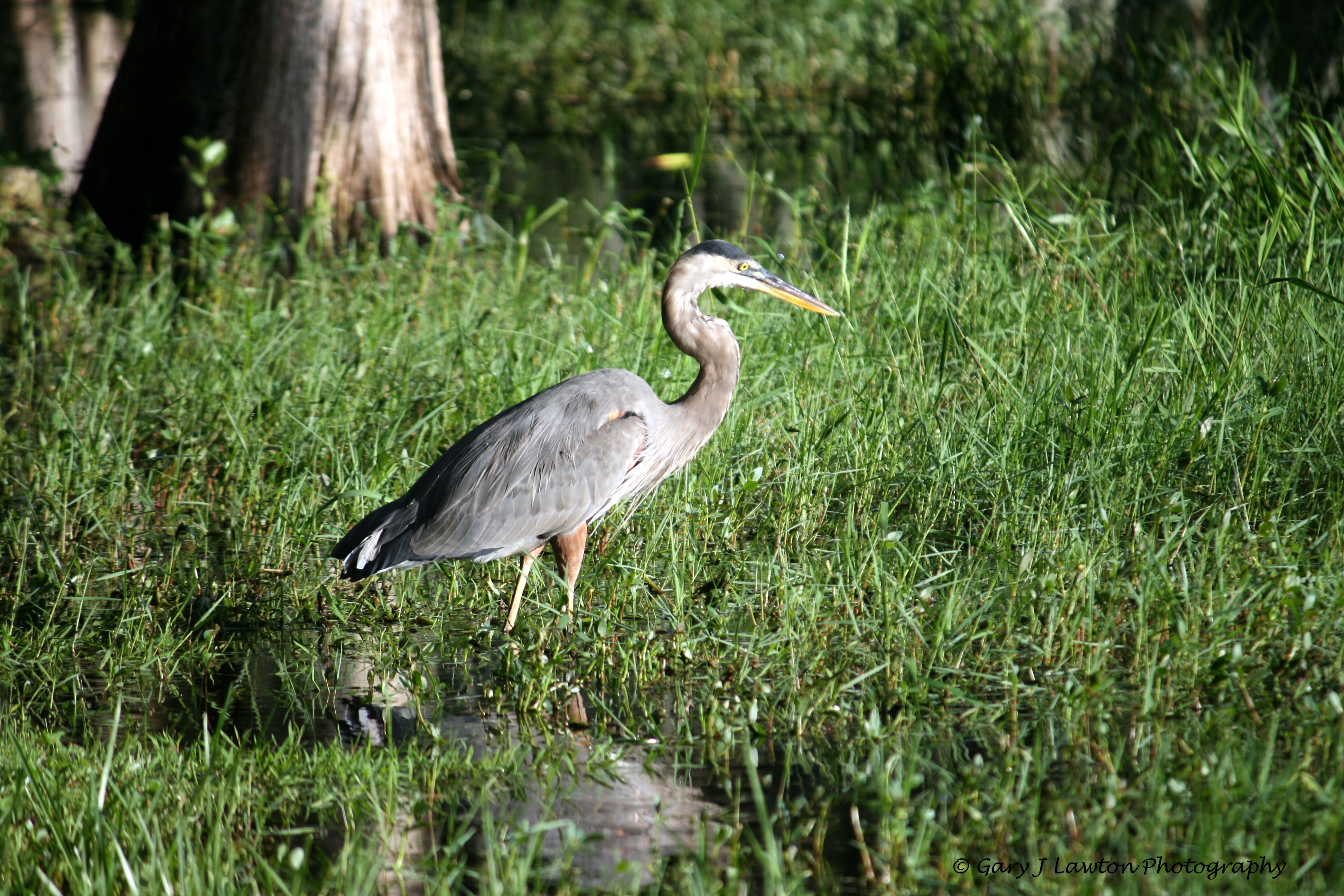
Great Blue Herons stand over 4 feet tall and have 5 foot wing spans.

It was a beautiful spring day along the Connetquot River on New York’s Long Island. The crisp morning air was washed of smog from spring rains that fell overnight. Raindrops, caught by the spring growth of swamp maples, black gums, and viburnums, glistened in the morning sun. As I walked along the edge of East Pond, one of several ponds that are part of the Connetquot watershed, green frogs leapt off the narrow trail into the water. A water snake, sunning itself on a patch of sphagnum moss, slithered into the water when it saw me draw closer. Mallard ducks, wary of my presence, paddled to the opposite side of the pond as a chatty kingfisher bird dropped to the pond to pick off a small fish.

The woods were alive with the singing birds. Common yellowthroat warblers, small birds that with black masks around the eyes, blurted out “witchity-witchity-witchity”. Yellow warblers, all yellow with breasts with rusty streaks sang “sweet-sweet-sweet, sweeter than sweet”. This was all music to my ears. I paused when I heard tapping coming from the top of a dead swamp maple tree, stripped of its bark by weathering, insects and wildlife. Several holes, at varying heights, revealed the rotten inside of the tree where woodpeckers carved out the soft wood to raise young. Near the top of the 30 foot tall tree was a hairy woodpecker. It was working its way around the tree trunk tapping at various places, probably to extract insects from the dead wood.

As I continued my walk, my mind drifted off to a time a hundred years ago when this property was owned by a sportsmen’s club. Members of the club included the who’s who of the late 1800s and early 1900s. Did members of the Roosevelt family hike this very path to fish and hunt here? If so, did they enjoy the peace and tranquility that I am enjoying now? If I met the Vanderbilts, would… “Sqaaaawkkkkk.” A shot, no, a pint, of adrenaline streamed through my body. I felt it in my arms, legs,  and head. My heart pounded my chest. I don’t know if I temporarily stopped breathing at that moment or not.  “Sqaaaawwwkkkk.” What the…???? I looked up to see a pterodactyl-like creature rise up. Its 5 foot wingspan nearly engulfed me. I felt the rush of wind as it rose up off the path. I froze, the adrenalin coursing through my veins.

It was a great-blue heron that, in my daydreaming, I did not see until I turned around a bend in the trail to find myself suddenly upon it. This 4 foot plus tall stork-like bird was as surprised to see me as I was to see it. Its adrenalin pump caused it to flee, not confront the 5’ 8” animal that was upon it. The harsh squawk startled its potential predator, me, long enough for it to get away and it worked. I froze, first because of the loud shrieks, then because of its 5 foot wingspan.

Once I recovered from the blast of adrenalin, I continued on the path, more vigilant of what was on the trail. Frogs continued to jump into the water, birds flew away and turtles slid into the pond – all to escape what they perceived a threat to their well-being. I thought about what is must be like to be a rabbit, a mouse, a frog – the hunted.  The adrenalin rush that I experienced just moments ago, must be a daily occurrence for the hunted. The trail led me back to civilization and at that moment I was glad that I was a human, an animal on the top of the food chain and not among the hunted.