3 Comments

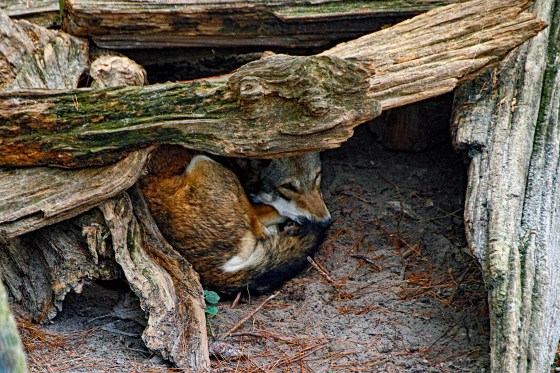
World’s Most Endangered Canid


Wolves have been vilified by humans for centuries from children’s fairy tales – “Then I’ll huff and I’ll puff and I’ll blow your house down.” – Little Red Riding Hood and the wolf in a sheep’s clothing to the haunting howl of a wolf played in the background of scary shows to werewolf movies.

This stereotyping of wolves has not boded well for the red wolf. They have been the target of predator control measures, shot and killed just because they are wolves. Once common in eastern U.S. forests, the red wolf was declared extinct in the wild in the early 1970’s. The remaining wolves were now confined to zoos and wildlife centers.

A breeding program with the captive wolves saved the species and in the 1980’s red wolves were released in the wild in a North Carolina wildlife refuge. As of 2015 there were over 50 wolves in the refuge.

This species is still in a perilous state. Despite recovery efforts by the U.S. Fish and Wildlife Service these wolves have not fared well. Many people remain ignorant of the benefits and importance of wolves in the environment and have balked and thwarted the agency’s attempts to re-establish the red wolf population.

Wolves play an important role in the environment in keeping elk, deer and moose in check. This results in a greater biodiversity of plant and animals. In Yellowstone where gray wolves were re-introduced, aspen groves rebounded resulting in increasing habitat for a variety of birds, stabilizing stream banks and providing resources for beavers to build dams. Overall the park now has a healthier natural environment.

Until people overcome their unfounded fears of an animal they know little about, the red wolf will have a difficult road to come back from the brink of extinction.

Leave a comment

Wild Cats in Florida

Rabbits, squirrels, raccoons, opossums and birds beware. There is a predator on the loose in Florida. It is a large cat with a short tail and dark spots. It is a skillful and stealthy hunter; it has keen eyesight, razor-sharp claws and sharp teeth. If it catches you, you will be dinner.

The Florida bobcat is ubiquitous in Florida. It lives in woodlands, wetlands and suburban yards. Many people are alarmed when they see bobcats in their neighborhoods, but this feline is a secretive, shy creature and tries to remain hidden from humans.

Bobcats are often mistaken for the Florida panther, a much larger cat that lives in Florida. Bobcat populations are secure in Florida although as suburbia infringes on natural areas, there is likely to be some conflicts between these wild cats and people and their pets.

Leave a comment

The Florida Peninsula Cooter Turtle

This freshwater turtle is common in the coastal plain of southeast of U.S. and is found in just about any pond in Florida. A larger turtle than the red-eared slider, it grows on the average of 9 – 15 inches. This cooter is primarily a herbivore eating aquatic plants including algae and underwater herbs. It digs a three-chambered nest on the lake shore where it lays most of its eggs in the center cavity with one egg in the two side holes. Although habitat destruction has affected this species, its population still remains stable.

Leave a comment

The Red-eared Slider: A Southern U.S. Native and an Invasive Species Elsewhere

A native of Mexico and the southern U.S. the red-eared slider can be found in just about any lake. They are easily identified with a distinct red strip on both sides of their head. When young, these turtles eat insects and other aquatic organisms, but as an adult the red-eared slider becomes a herbivore (vegetarian).

Sliders are often sold in pet shops as hatchlings and if cared for properly, they will grow and grow and grow. And as they grow they need bigger and bigger and bigger tanks requiring lots of cleaning and care. Oftentimes, people grow weary of the upkeep and will release their pet turtle into a local pond.

When these turtles are released in waterways outside of their home range, red-eared sliders can wreak havoc on native turtles. Studies have shown that red-eared sliders negatively impact the growth of native turtle species. They often out-compete native turtles for food, nesting locations and basking places.

Having a red-eared slider as a pet is a 20-year commitment. They might be cute as babies, but sliders require a lot of care as they get older. Some places have banned the sale of red-eared sliders due to their invasiveness. If you have one that you no longer want seek assistance with local wildlife centers to find a home for your pet. Above all, think before you buy!

Leave a comment

Wintering Chipping Sparrows

One of my favorite winter birds is the chipping sparrow. These petite sparrows are easily identified by a rusty-brown cap on an otherwise dull underbelly with brown striped wings and back. A black stripe through the eye is another identifying feature of this bird. Chipping sparrows migrate south for the winter and each year they visit our backyard feeders.

If you look closely at its bill, you will see it is not as pointed as a warbler’s bill; its beak is broader (see “Florida’s Winter Warbler”). This is typical of seed eating birds. In the wild, these sparrows seek out seeds from grasses, sedges and other herbaceous plants.

Towards the end of the winter, chipping sparrows will head north to their breeding grounds where they will build a small flimsy nest to lay their eggs and raise their young. When I lived in New York, the chipping sparrows seemed to gravitate around the evergreen trees where I occasionally found a nest in branches that were under ten feet off the ground.

Although the chipping sparrow population has declined in recent years, it is still healthy. It would not feel like winter in Florida if I did not see these pretty birds at my feeder.