Leave a comment

The Bird That Swims With Its Feet

During a recent kayak trip on Lake Tsala Apopka, Florida, I heard the cackling call of the common gallinule coming from a freshwater wetland bordering the pond. As I glided towards the marshland I saw two adults with two nearly fledged chicks swimming amongst water lilies and reeds.

To a novice, the common gallinule may be mistaken for a duck. It swims like a duck. It lives in lakes and freshwater wetlands like ducks. But this bird lacks webbed feet that ducks use to swim. It is an adept swimmer with its feet.

Not alarmed by me in the kayak, I was able to watch the family walk on lily pads and climb over fallen logs and branches in the swamp going from one area to another to eat aquatic plants and freshwater snails.

This species is fairly stable over most of its range (northern U.S. to Chile), but any loss of wetlands will impact the common gallinule in the future.
Leave a comment

Another Abundant Penguin Species

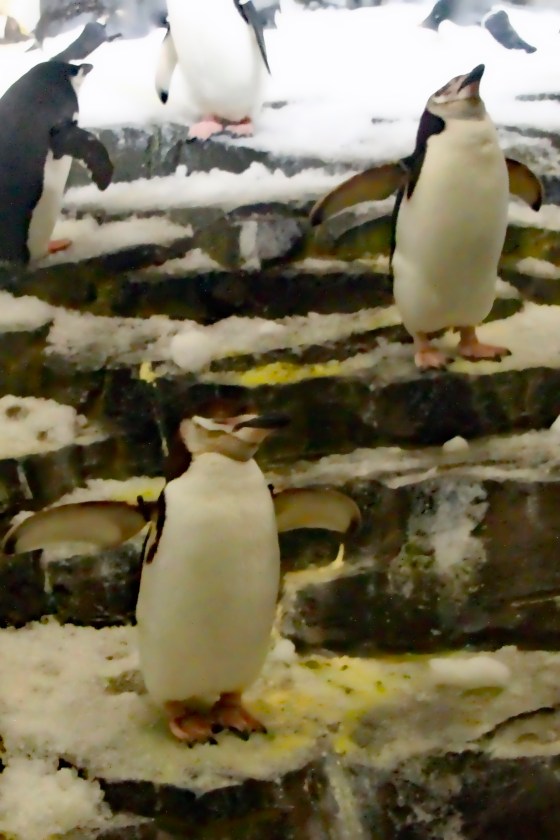
The chinstrap penguins are medium-sized penguins that live in the sub-Antarctic and Antarctic Islands in the south Atlantic Ocean.Theses birds avoid ice packs and prefers rocky, snow free slopes to breed. This species primary food is krill and like other penguin species leopard seals are the primary predator.

Like the rockhopper penguins, this is also an abundant species and its population is one the rise. One theory is that hunters have harvested so many whales that the krill, the primary food of chinstraps, has increased providing lots of food for this penguin.

Leave a comment

World’s Most Abundant Penguin

Unlike other penguins that waddle as they walk or slide on their bellies on snow, the rockhopper penguin hops over rocks and stones on the rocky coasts they live on. The rockhopper penguin was thought to be a single species, but it has been determined that there are 3 distinct species. Rockhoppers live at the tip of South America, on the Falkland Islands and other outlying Antarctic Islands.

These small penguins eat krill, shrimp, crabs, squid and similar marine life in the southern oceans. When hunting, rockhoppers must look out for leopard seals, sharks and killer whales that feast on penguins.

Although numbering seven million individuals, the rockhopper penguin has decreased by 90% since the early 1900’s. The reason for the drop is unknown, but scientists suspect that pollution, fishing by humans and climate change is contributing to this penguin’s decline.

Leave a comment

Penguin of the Sea

The Adelie penguin migrates to sea in the Antarctic winter where it lives amongst the pack ice consuming its preferred food – krill. During the Antarctic summer, from October to February these medium-sized penguins return to the exposed rocky shores of Antarctica where they breed in large colonies.

By mid-November, after making a nest of pebbles, the female lays two eggs and the male takes turns with the female incubating the eggs. The chicks hatch in December and are fledged with their adult feathers in February when they head to the sea.

The cold Antarctic waters are dangerous with leopard seals stalking the penguins.

Being well adapted to the cold climate 2.5 million pairs of Adelie penguins live in the Antarctic region and are relatively secure in their population.

3 Comments

World’s Second Largest Penguin

The king penguin takes this title with its 3-foot stature, second only to the large emperor penguin that is 4 feet tall. It lives in colonies numbering 10’s of thousands of pairs on various the sub-Antarctic islands.

This penguin’s main diet is fish, but it also eats some krill. Leopard seals are a constant danger to the penguin when it is in the cold Antarctic waters.

A king penguin pair does not build a nest, but incubate a single egg on their feet covered by a brood pouch on their belly. The couple takes turns with this process until the chick hatches about 55 days later. The chick takes a long time to fledge – about 15 months and is not able to breed until it is three to five years old. This results in a pair only able to raise two chicks in three years.

You might think that this is a recipe for a decline in this bird’s population, but it remains a large stable population with four to five million birds. In the 18 and 19 hundred’s people hunted the king penguin resulting in some colonies being eradicated, but the banning of commercial hunting helped them rebound. (Photograph from Empire of the Penguin exhibit at SeaWorld, Florida.)